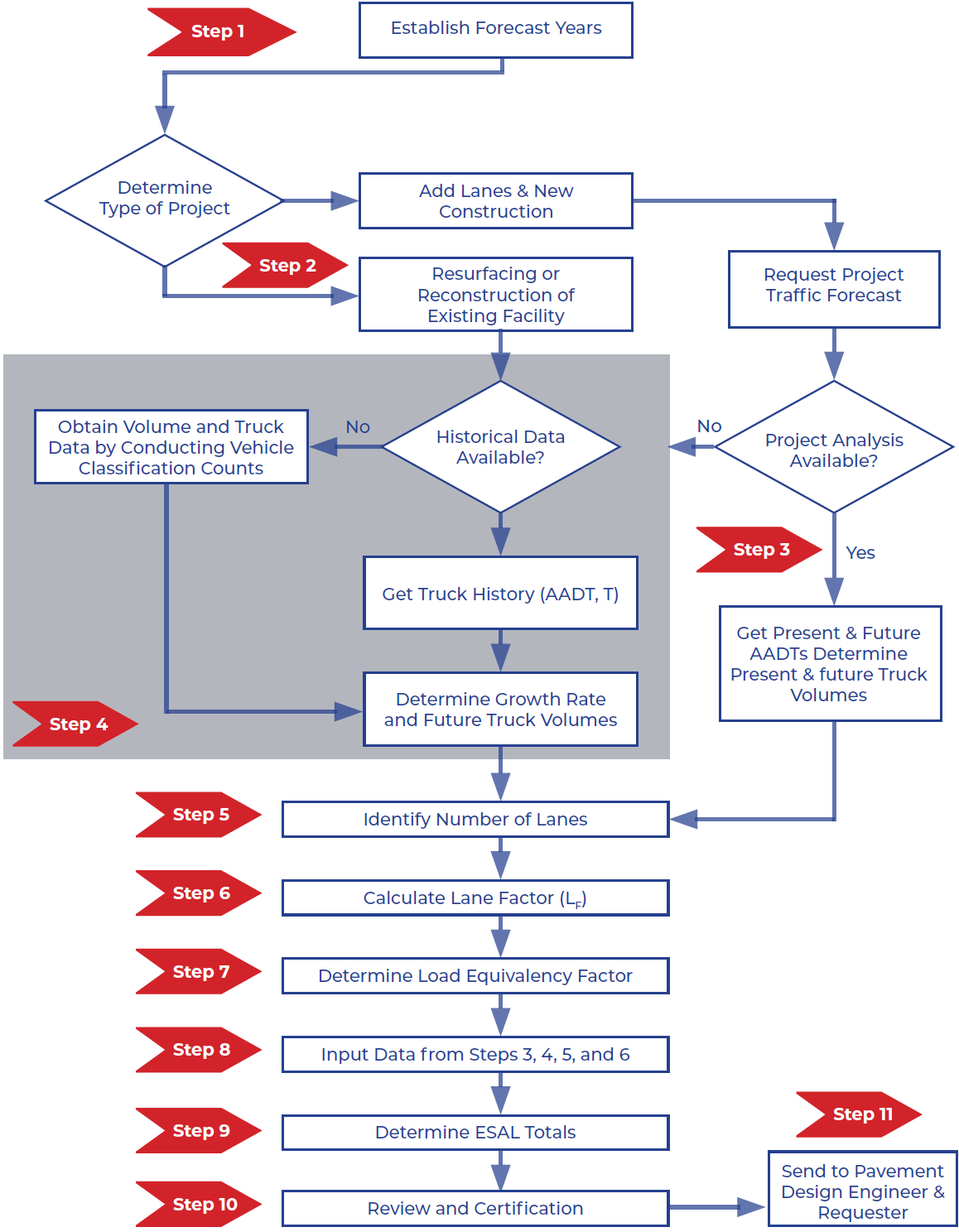
Figure 8-1 shows the ESAL Forecasting Process and identifies the steps to be taken to develop the expected ESALs for the life of a highway project. The design period for a project should be at least 20 years from the anticipated year the project is open to traffic. The ESAL forecasting process involves developing heavy truck traffic, determining damage factors, and generating ESAL estimates.
Many of the FSUTMS-based models, such as the Tampa Bay Regional Planning Model (TBRPM) have the capability of forecasting truck traffic. The percentage of truck traffic is assumed to hold the same relationship to AADT unless some anticipated development changes the future truck traffic pattern.
Truck data is collected through vehicle classification counts and vehicle classes 4 through 13 are used for the purpose of determining and forecasting ESALs and truck traffic (see Chapter Figure 2-1 FHWA Vehicle Classification Scheme “F”).
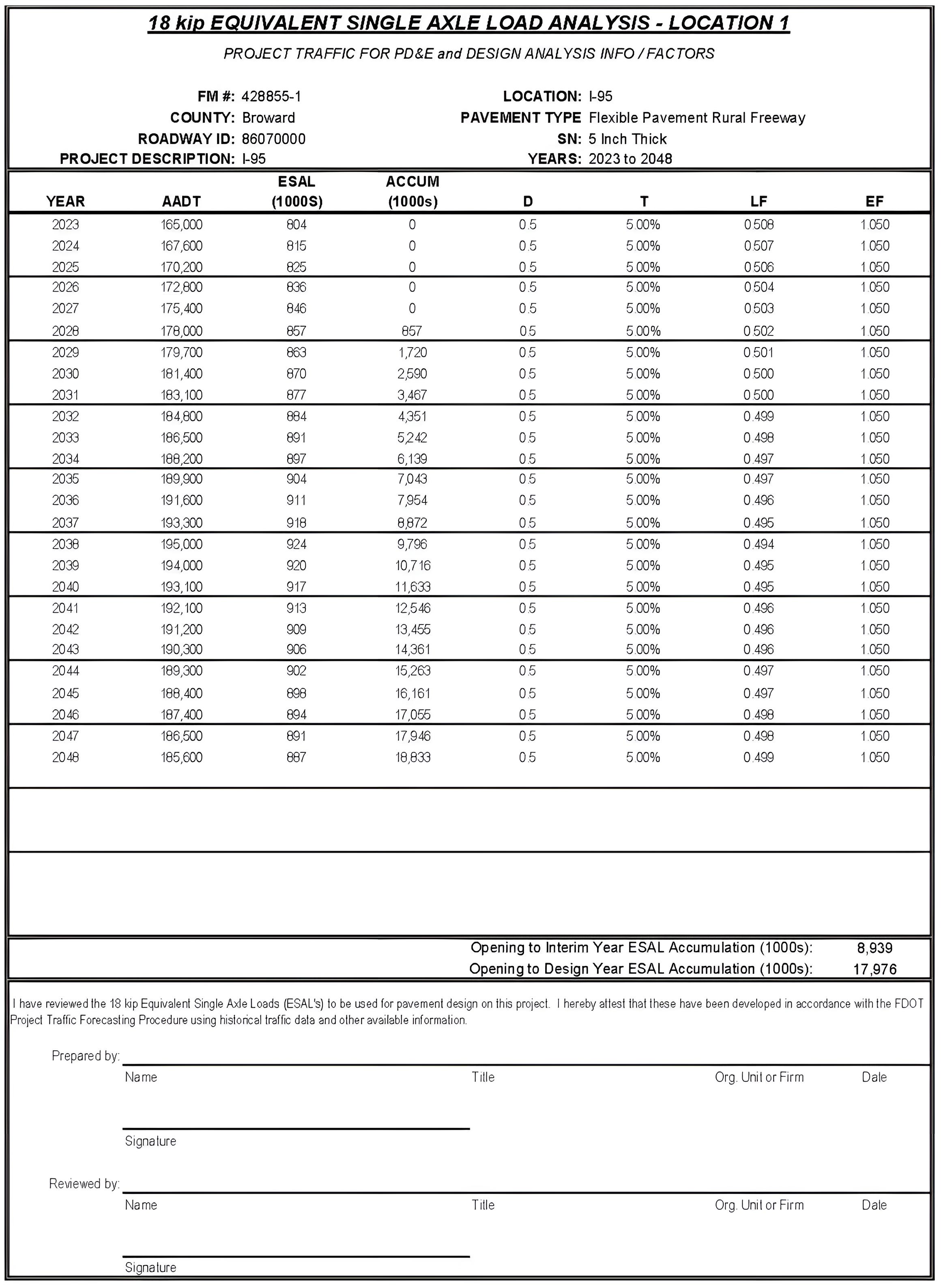
The damage factor estimates are based on analysis of historical traffic weight data collected from “Weigh-In-Motion” (WIM) surveys. The survey data is combined with other data such as functional classification, roadway type, number of lanes, highway direction (DF), percent trucks (T), lane factor (LF), and truck equivalency factor (EF or E80), to estimate the accumulated 18-KIP ESALs from the opening year to the design year of the project. An Excel Spreadsheet is developed to facilitate the ESAL estimates.
Projections
Predictions of future truck volumes are often based on historical traffic data. Several factors caninfluence future truck volumes, such as land use changes, economic conditions and new or competing roadways. Truck volumes may decrease, remain constant, or increase. The change may be described as a straight line, an accelerating (compound) rate, or a decelerating rate.
A pavement design may be part of new construction or reconstruction with the addition of lanes, where a diversion effect from other facilities may be a concern. Such a project, where the growth pattern is expected to differ from the historical pattern, will be subject to a “Project Analysis”. This project analysis should include consideration of historical trends (area-wide or project location specific), land use changes, and an evaluation of competing roadways.
Accumulations
The accumulation process calculates a series of truck volumes, corresponding to successive years, by interpolating between the base (opening) year and the design year. The 18-KIP ESALs to be used for pavement design are calculated for each year, accumulated, and reported in a table as shown in Figure 8-2.
Traffic Breaks
If a project has two or more traffic breaks within the project limits and the determined current volumes differ significantly, the project is split where appropriate and separate forecasts are prepared for the Pavement Design Engineer.