The FDOT Traffic Data Collection Program covers both vehicular traffic (e.g., trucks, automobiles, and motorcycles) on the roadways and non-motorized traffic, such as bicycles and pedestrians on sidewalks, bikeways, and trails. While it is important to collect and analyze non-motorized traffic data, the focus of this chapter is motorized traffic data. Users are advised to refer to the 2023 Florida Traffic Monitoring Handbook for details on non-motorized traffic data collection.
Traffic Count Site Types
FDOT operates two types of traffic count site: Continuous Traffic Monitoring Site (Continuous TMS) and Short-term Traffic Monitoring Site (Short-term TMS).
The continuous sites are designed to collect various traffic data 24 hours per day, 365 days per year. The data collected is transmitted to TDA Office using a wireless cellular device. Information from these sites is used to determine traffic growth and tendencies, as well as develop pavement design input, seasonal adjustment factors used in determining estimates of AADT, axle correction factors for road tube counts, and Directional Design Hour Volumes (DDHV). In 2022, there were 386 active continuous sites in the State. There were also an additional 46 sites that collect information on vehicle classification and truck weights, known as Weigh-in-Motion (WIM). The TDA Office will determine when and where new Continuous TMS are required. Often when major road construction projects are undertaken, a count site will be included in the design plans at the request of the TDA Office. Generally, three (3) to four (4) new sites are installed each year and several others receive equipment upgrades. Continuous counters provide the user with day-to-day traffic information throughout the year.
The Short-term TMS are designed to collect traffic counts for a short period of time, usually between 24 and 72 hours. Short-term TMS can be permanently or temporarily established. As a part of the statewide count program administered by the FDOT District Offices, each road section is generally counted approximately every three (3) years. It is the responsibility of each District to determine the location of short-term, non-continuous traffic monitoring sites. The exact location and count type should be determined by the physical geometry of the road. Each time a count is made, the technician will re-evaluate the site to determine if field conditions are still suitable for obtaining an accurate count. Factors that should be considered when selecting site locations include the presence of curves, crests, valleys, driveways, intersections, schools, number of lanes, medians, shoulders, and turn lanes. In 2022, there were 18,746 active short-term counts sites across the State. Short-term counts are used to develop growth factors for estimating current year counts from known prior year counts and determine Vehicle Miles Traveled (VMT).
The various types of traffic monitoring sites used in Florida in 2022 are illustrated in Figure 2-1. The FDOT TDA Office and District Offices collected traffic counts at 19,178 sites throughout Florida, providing important information for all aspects of transportation decision making, including both program and project development.
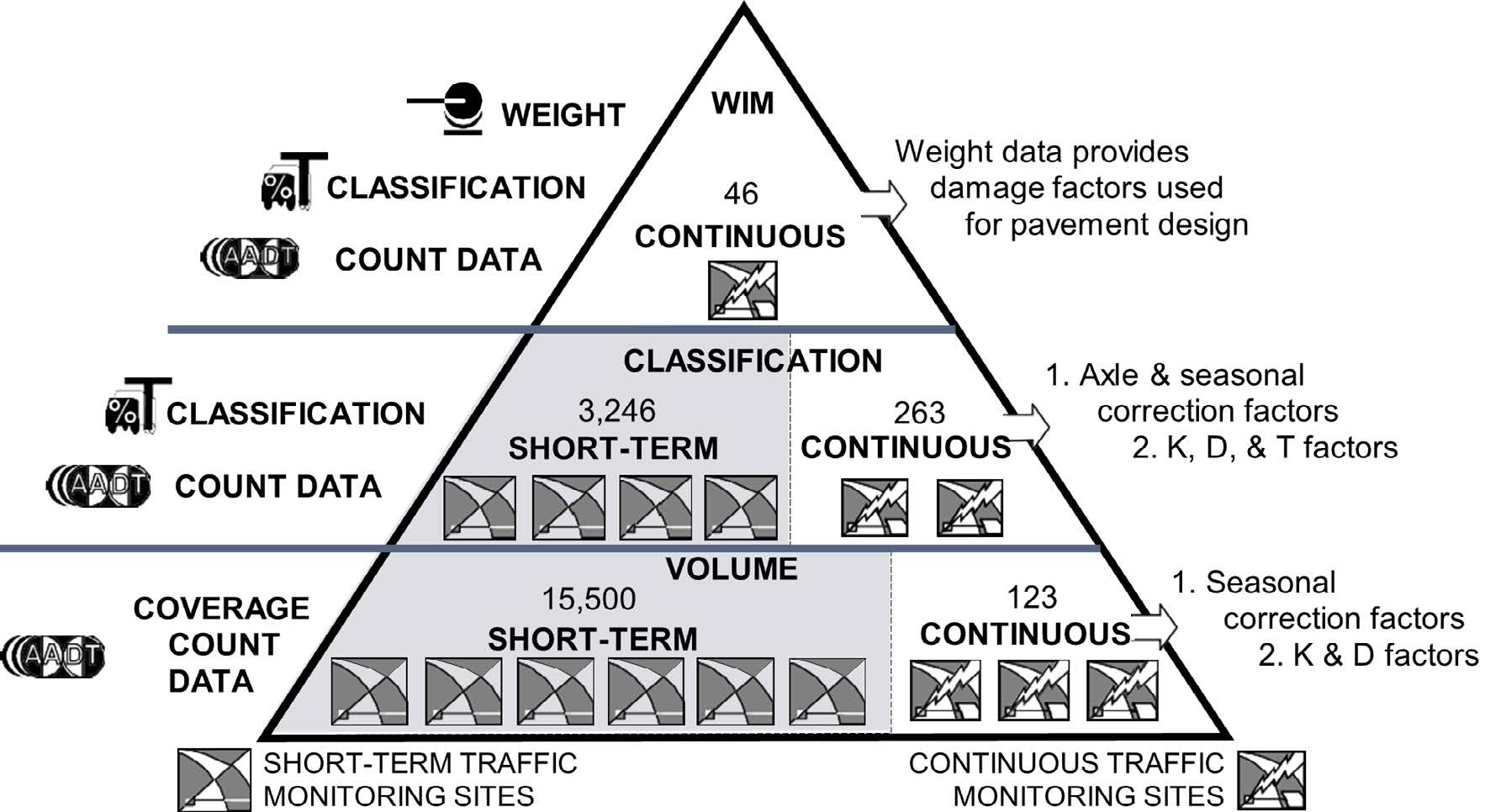
Types of Traffic Counts
2.3.2.1 Volume Counts
There are two (2) different types of volume counts that can be collected:
- Axle Volume Counts – are obtained when a single road tube is set across a road. The counter connected to this road tube divides the number of axles (number of hits) on the tube by two (2) to derive a count. This type of count data requires an ACF to calculate the vehicle count. An ACF is assigned to the specific count location based on the characteristics of the truck traffic at that location.
- Vehicle Volume Counts– are obtained from counters using sensors, such as inductive loops, microwave devices, and magnetic vehicle detectors. These counters detect an entire vehicle, not solely its axles. If the counting device counts the “number of vehicles,” the count is known as vehicle count. The count site will not require an axle correction factor. All of Florida’s continuous traffic monitoring sites can collect vehicle volume data. The data is collected for each lane, and usually in one-hour intervals. In addition, all toll facilities collect continuous traffic counts at the tolling locations.
2.3.2.2 Vehicle Classification Counts
Vehicle classification consists of collecting traffic data with counters that detect axles and measure the distances between axles on each vehicle. The vehicle is then classified per the criteria contained in FHWA Vehicle Classification Scheme “F” (Figure 2-2). Classification data is usually collected using a combination of presence (loops) and piezoelectric axle sensors.
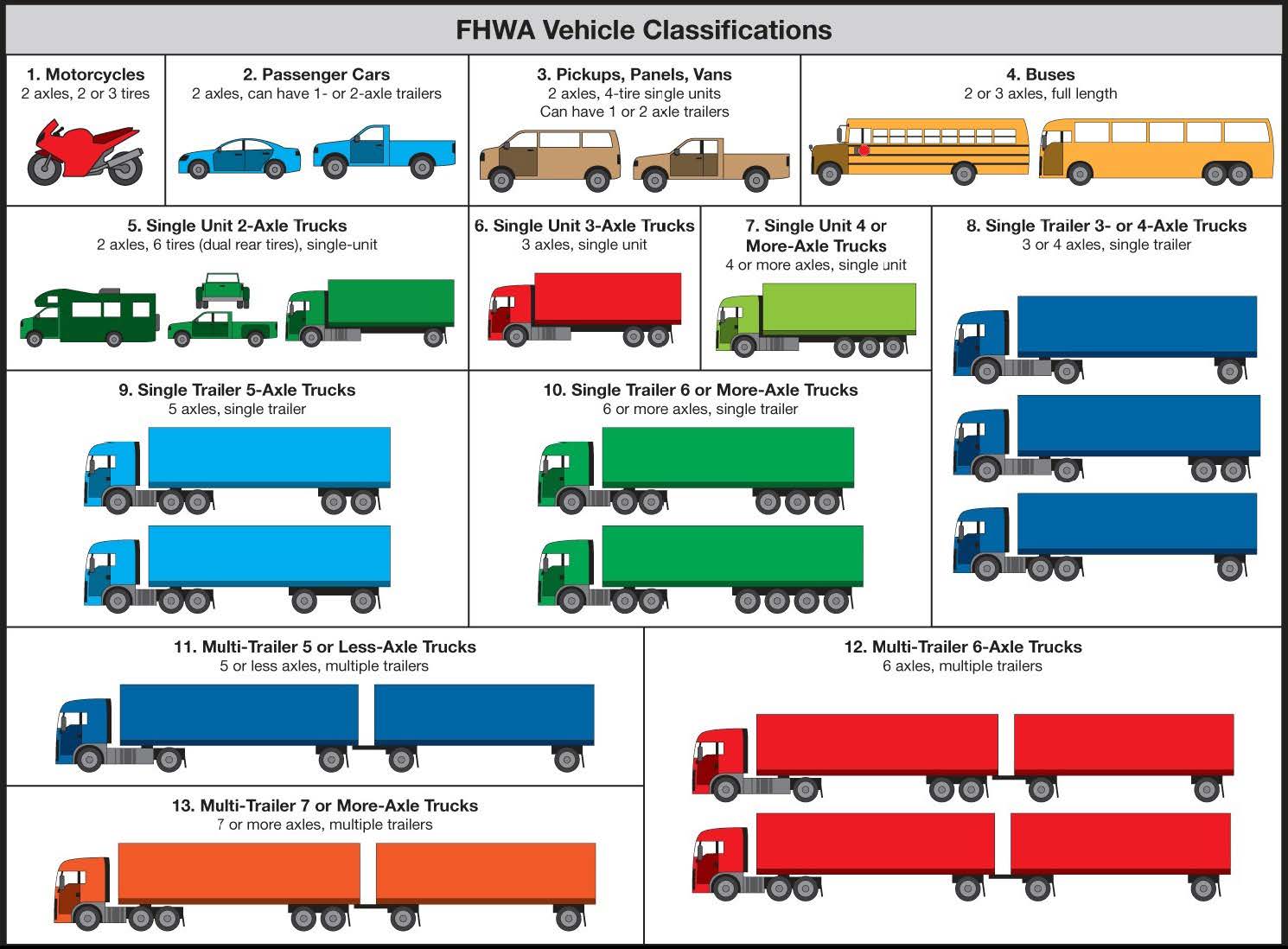
Vehicle classification counts obtained at approximately two-thirds of the count locations are used to develop axle correction factors. Axle correction factors are computed for each highway functional classification category in each FDOT region. Limited Speed data is also collected during vehicle classification counts. The Continuous Traffic Monitoring sites are built to collect vehicle classification, volume, and speed counts.
2.3.2.3Traffic Speed Counts
All Continuous traffic monitoring sites can collect vehicle speed data. Equipment required to collect speed data are two (2) inductive loop sensors. Since 1995, all such sites have been routinely programmed to collect this data in binned files. Florida currently bins the speed data into 15 categories from below 20 mph to over 86 mph, in 5 mph intervals.
Acceptable Time Periods and Duration for Data Collection
Traffic counts should be collected during a time period when traffic patterns are representative for the project. For most studies, this means peak periods during typical weekdays from Tuesdays to Thursdays. Traffic counts should not be collected when the schools are closed. However, for special studies in recreational or tourist areas, especially in areas near cruise ports, traffic counts can be collected during the weekends including Fridays, Saturdays, or Sundays. Collecting data prior to, during, or right after holidays or special events should be avoided.
The duration of the volume or classification count is dependent on the requirements of the District, as well as the project. For the Annual Count Programs throughout the Districts, count locations are identified by the functional classification of the road on which they are located as either ‘Rural’ or ‘Urban’. Because there is more day-to-day variation in the traffic flow in rural areas, a longer count duration is required to minimize this variation. The minimum requirements for Rural and Urban counts are as follows:
- Rural: minimum of 48-hours of continuous data in 15-minute intervals
- Urban: minimum of 24-hours of continuous data in 15-minute intervals
Short-Term Seasonal Classification Counts
FDOT has approximately 3,200 locations where short-term seasonal classification counts are performed. These Short-term TMS are automatic traffic recorders that are temporarily placed at specific locations throughout the State to record the distribution and variation of traffic flow. These counts are performed one (1) or more times a year (24-hour or 48-hour each), as deemed necessary, to capture the seasonal truck variation. The seasonal classification counts, together with classification counts collected at Continuous TMS, are used to estimate the axle correction factors and determine the percentage of trucks.