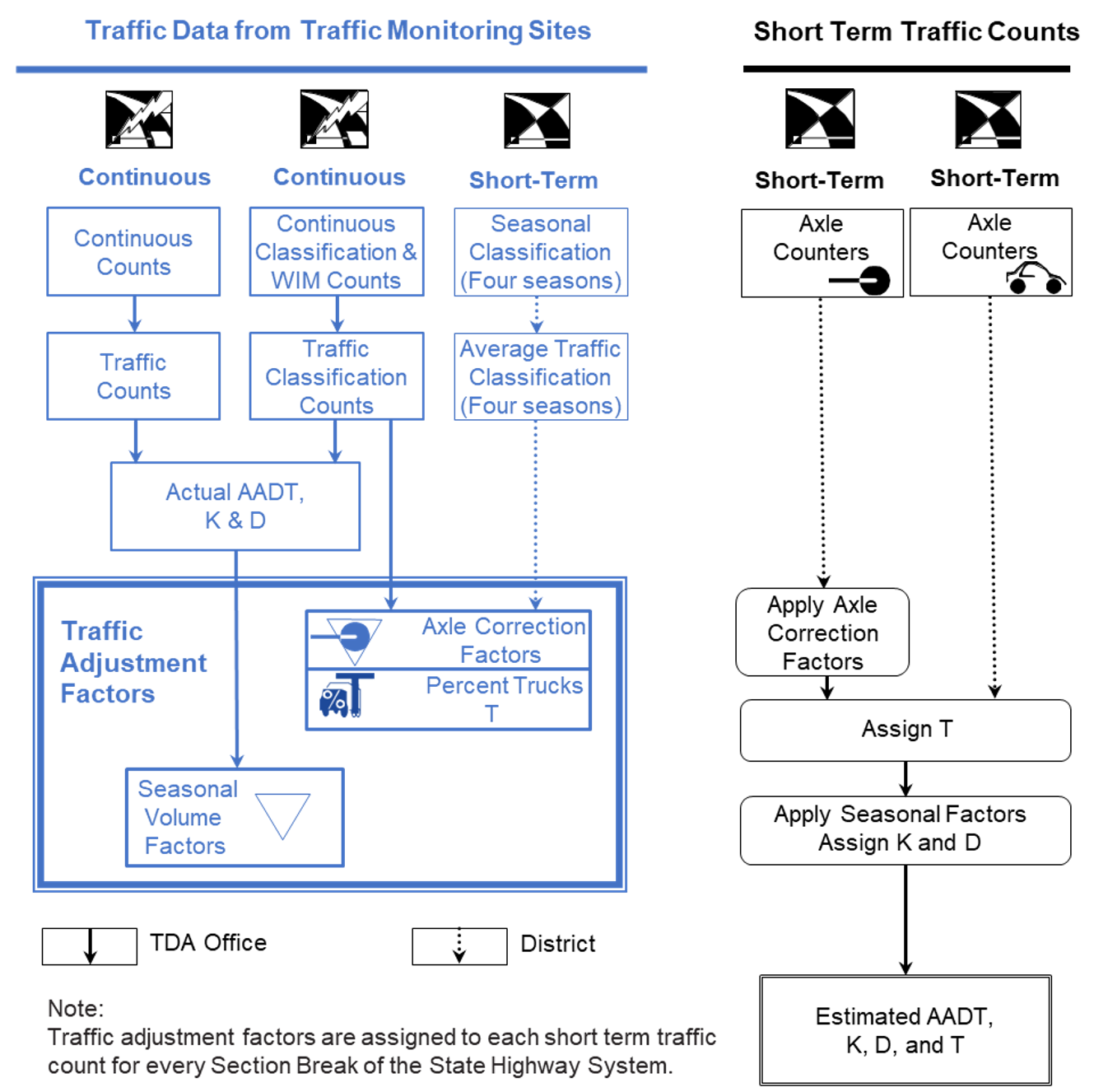
The two (2) traffic adjustment factors, Seasonal and Axle Correction, are calculated by the TDA Office and can be accessed through either the Traffic Characteristics Inventory (TCI) database or the (FTO website). Both TCI and FTO contain current and historical data. Continuous counts and seasonal classification counts provide the necessary information to establish traffic adjustment factors. In the absence of any continuous counts within a county, TDA Office applies seasonal factors from adjacent counties and develops seasonal factors for those counties. These adjustment factors are later applied to the short-term counts to estimate AADT, K, D, and T factors. Actual AADT, K, D, and T data are collected from permanent, continuous counters. Figure 2-3 shows the process of developing traffic adjustment factors and applying them to estimate AADT and other traffic parameters from short-term traffic counts.

Seasonal Factor (SF)
All short-term counts must be adjusted to reflect the seasonal changes in traffic volumes. The TDA Office determines the Seasonal Factor category using traffic data collected from permanent count locations. The FDOT districts assign a Seasonal Factor category to each short-term traffic count site. The basic assumption is that seasonal variability and traffic characteristics of short-term and permanent continuous counts are similar.
The Monthly Seasonal Factor (MSF) for a particular month at a particular location is derived from the AADT for a location divided by the Monthly Average Daily Traffic (MADT) for a specific month at that count site as shown in Equation 2-1.
Weekly Seasonal Factors (SF) are developed by interpolating between the monthly factors for two (2) consecutive months as shown in Equation 2-2. The SFs are calculated for each week of the year for each continuous count station and recorded in a Peak Season Factor Report available on FTO Website.
Where:
\(SF\) = Weekly Seasonal Factor.
\(MSF_i\) = Monthly Seasonal Factor for a particular month i; the MSFs are assigned to the week of the year that contains the midpoint of the month.
\(MSF_{i+1}\) = Monthly Seasonal Factor for the following month i+1.
\(N\) = Number of weeks between the midpoint of month i and the midpoint of the following month i+1, usually 4.
\(n\) = Number of weeks between the midpoint of the month i and the week for SF, usually between 1 and 4.
Axle Correction Factor (ACF)
ACFs are developed from classification counts by dividing the total number of vehicles counted by the total number of axles on these vehicles. ACFs are determined by using the data from continuous and short-term classification counts following the guidelines as described in the FHWA Traffic Monitoring Guide.
The information collected from the traffic monitoring sites is used to determine the traffic adjustment factors, such as ACFs, Percent Trucks, and Seasonal Volume Factors. These adjustment factors are applied to short-term traffic counts taken by portable axle and vehicle counters to estimate AADT, K, D, and T for every section break of the SHS as shown in Figure 2-3.